
Thermal insulation in Mauritius.
Corrugated iron roof, concrete slab, loft or exposed walls: Nova insulates your home to keep it cool, use the air conditioning less and soften the noise of the rain.
- Visit and measurements before any quote
- Insulation chosen to suit the surface and exposure
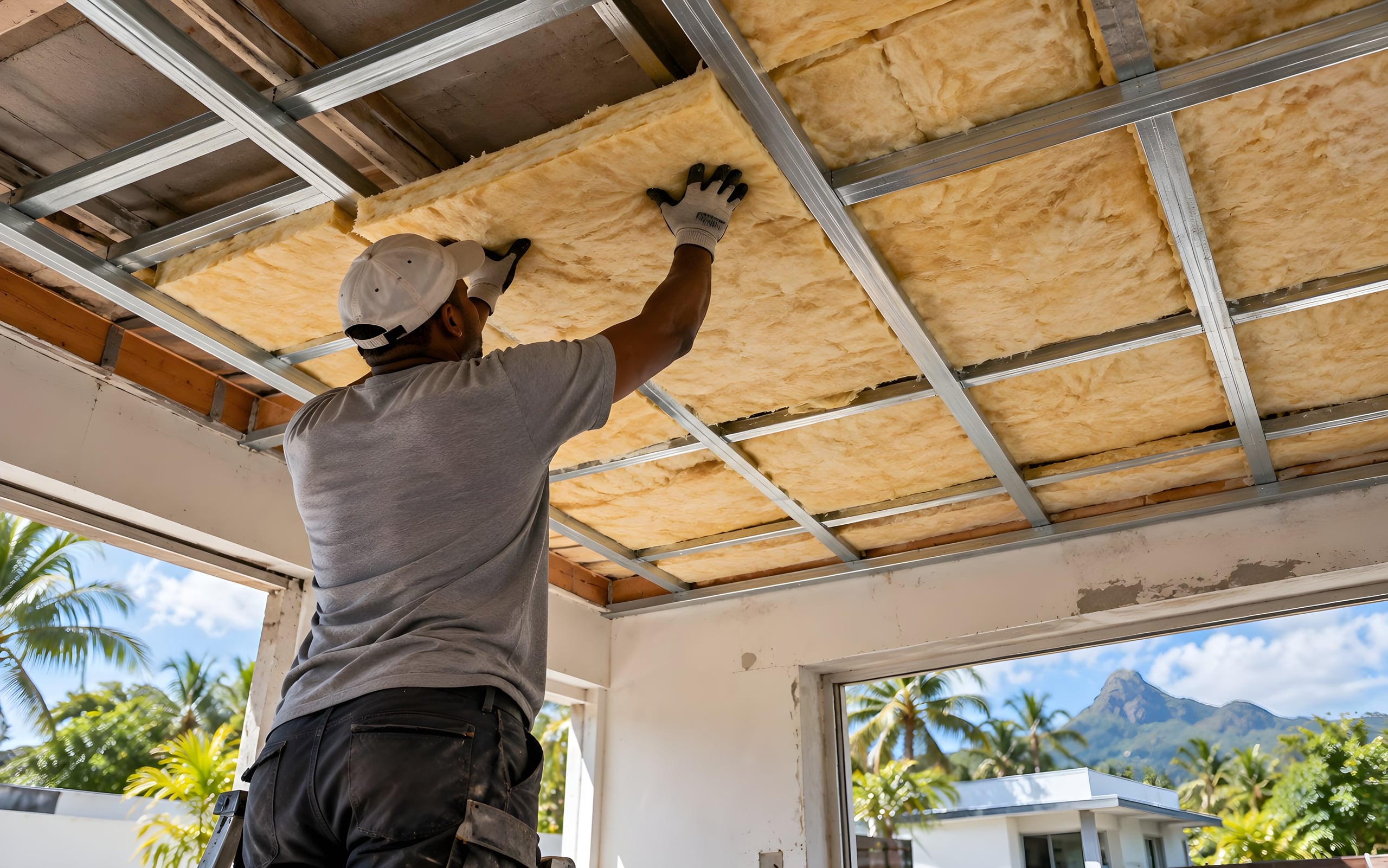
A house that’s too hot can be fixed.
From the visit to the finished ceiling.
- STEP 1Visit and measurementsSurveying the areas, the surface and the ventilation.
- STEP 2Detailed quoteInsulation, thickness and finish, itemised.
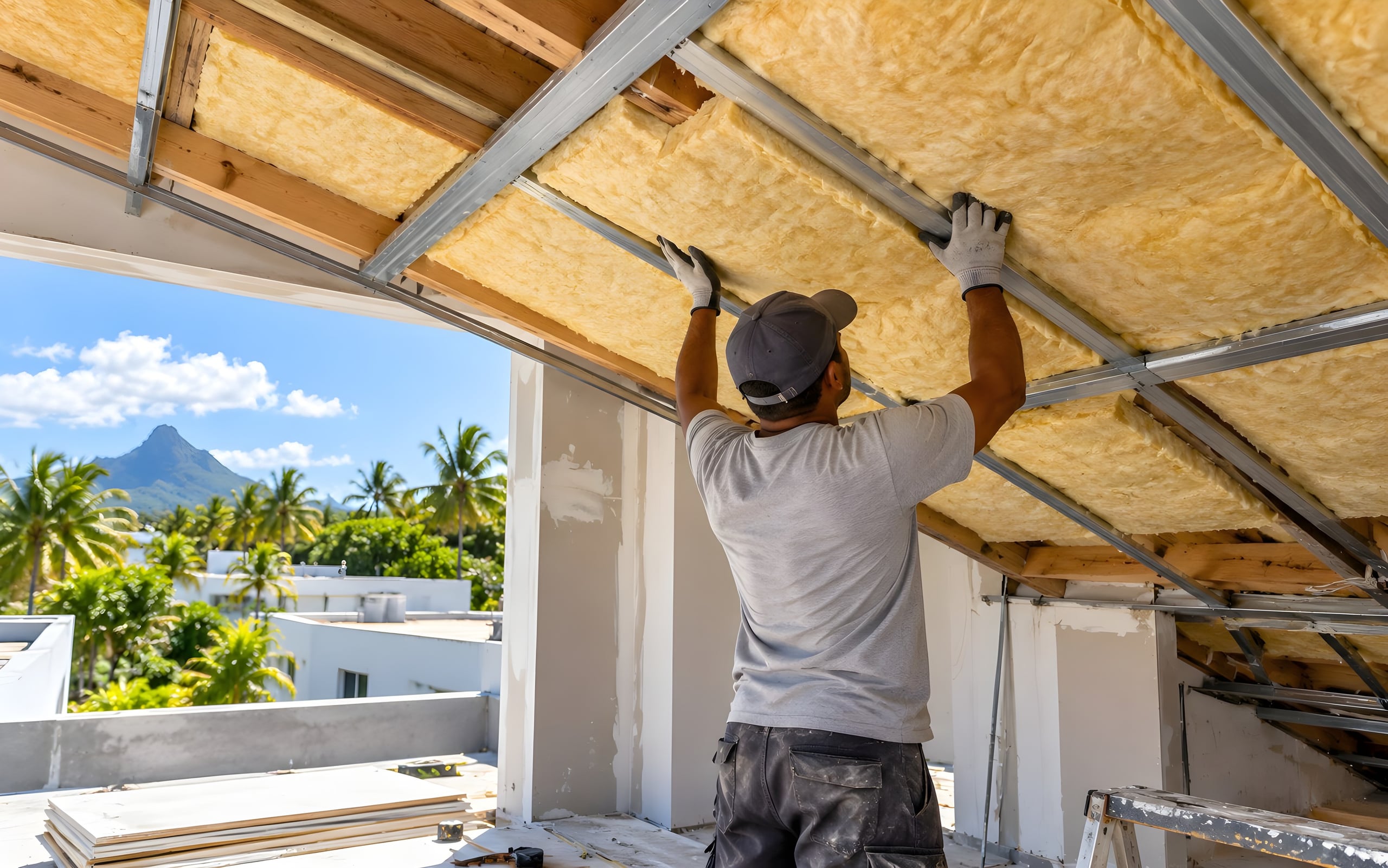
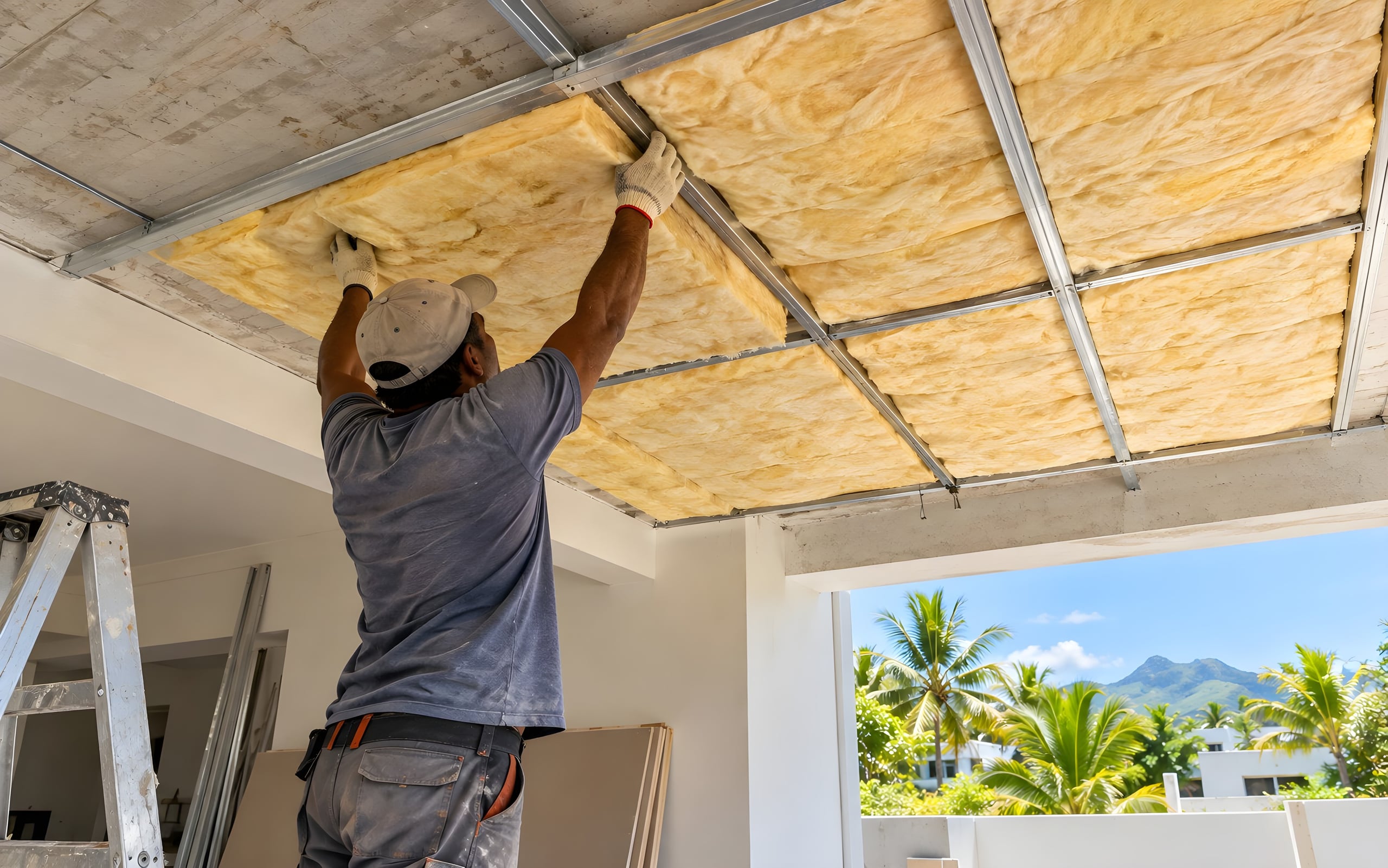
- STEP 3Frame and insulationMetal rails fitted, panels butted tight with no gaps.
- STEP 4Finishing and checkCeiling closed up, cleaning and end-of-job photos.
Under the iron roof, under the slab.
Your insulation questions.
How much does roof insulation cost?
The price of roof insulation in Mauritius depends on the area, the type of roof (corrugated iron, concrete slab or loft), the insulation chosen, its thickness and the ceiling finish. Our agent takes measurements during a free visit, then draws up a detailed, itemised quote, with no obligation.
How much cooler will the house be?
How much cooler insulation makes a house depends on the house itself: type of roof, sun exposure, ventilation and the insulation fitted. An insulated roof lets less heat through to the rooms, which stay cooler in the afternoon and rely less on air conditioning. During the visit, our agent tells you what is realistic for your home in Mauritius, without promising figures.
Rock wool, glass wool or polystyrene: which insulation should I choose?
Rock wool and glass wool are mineral wools: non-combustible, they insulate against heat and are good at dampening noise, such as rain on an iron roof. Polystyrene, rigid and light, is little affected by water in its extruded form, but it is combustible and must be protected by a facing. The right insulation depends on the surface, the space available and the humidity: in Mauritius, our agent advises you on the one that suits your roof.
How do you insulate a corrugated iron roof?
To insulate a corrugated iron roof, a common solution is to fit insulation under the roofing, then close it in with a ceiling on a metal frame: both the heat and the noise of the rain are reduced. Reflective paint on the iron sheets can complement the insulation by limiting how hot the roof gets under the Mauritian sun. Our agent checks the condition of the sheets, the ventilation and the fixings before proposing a solution.
Can a flat-roofed house with a concrete slab be insulated?
Yes. A concrete slab exposed to the Mauritian sun stores heat during the day and releases it into the rooms in the evening. It can be insulated from below, with an insulated suspended ceiling, and kept from heating up from above with reflective paint, alongside waterproofing the roof terrace if needed. Our agent chooses the right combination during the visit.
Do you also insulate lofts and walls?
Yes: Nova insulates roofs, lofts and walls in Mauritius. In a loft, the insulation is laid on the ceiling or between its framing; for a sun-exposed wall, a plasterboard lining with insulation straightens the wall and limits the heat passing through it. Our agent measures the areas and proposes a solution for each part of the house.
Does insulation reduce the noise of rain on an iron roof?
Yes, it’s one of the benefits of insulating a corrugated iron roof in Mauritius: during the downpours of the austral summer, the insulation and the ceiling soften the noise of the rain, and mineral wools are particularly effective against noise. The result depends on the insulation, its thickness and careful fitting, with no gaps between the panels.
Does insulation solve condensation under the roof?
In the hot, humid climate of Mauritius, condensation under an iron roof or a slab often comes from the temperature difference between the roof and the air inside. Well-fitted insulation, with suitable ventilation, limits this and the mould marks on the ceiling. If the damp comes from a leak, the waterproofing has to be dealt with first: our agent can tell which it is during the visit.
How long does insulation work take?
How long an insulation job takes depends on the area, access to the roof or loft and the ceiling finish. Timescales are set out in Nova’s detailed quote, drawn up after the visit. Our agent also tells you whether you can stay in the house during the work and how the job is organised room by room.
Can insulation, a suspended ceiling and lighting be combined?
Yes: insulation under a roof is closed in with a ceiling, in plasterboard for example, which can take spotlights or LED strips. Nova handles the insulation, the suspended ceiling and the finishing with a single point of contact, and can add reflective paint or waterproofing on the roof. Everything goes into a single itemised quote.
What should I prepare before the visit for an insulation quote?
A few photos of the ceilings, any damp marks and the roof seen from outside help our agent prepare for the visit; attach them to the quote request or send them on WhatsApp. Also note the hottest rooms and the times of day when the heat is worst. During the free visit, our agent surveys the areas, the surface and the ventilation to draw up the insulation quote.
How do I get a quote for insulation in Mauritius?
For insulation, describe your project in a few clicks in Nova’s quote request, with photos of the roof and ceilings if you can. Our agent will call you back within 24 to 72 hours, on WhatsApp or by phone, to arrange a free visit anywhere in Mauritius. You then receive a detailed, itemised quote, free and with no obligation.
Do you work all over the island?
Yes, Nova works across the whole of Mauritius: the North (Grand Baie, Triolet, Pereybère), the West (Tamarin, Flic-en-Flac, Rivière Noire), the Centre (Moka, Quatre Bornes, Curepipe), the East (Flacq, Belle Mare, Trou d’Eau Douce) and the South (Mahébourg, Souillac, Bel Ombre). Give your town or village in the quote request: our agent will call you back within 24 to 72 hours to arrange a free visit to your home.
A project in mind? Let’s talk this week.
A minute to describe your project, or a WhatsApp message if you’d rather.